

Architecture& national identity
Or, how the built environment shapes the imagined nation whom it serves.

Architecture helps nations build, project, and preserve their identity — quietly informing the world’s collective mental images of those nations through spaces, symbols, and shared stories.
The idea that a nation’s identity can be built, brick by brick, is as old as nations themselves. Yet, in the age of soft power, when influence and admiration carry more weight than gunboats (or so we hope), architecture plays a role more subtle and more crucial than ever. It is the silent ambassador and can be the stage on which a country plays out its most flattering self-image, or its most hopeful aspirations.
If I say “Italy,” I can pretty much guarantee that the images that pop up in your mind’s eye will be three or four of the list of five iconic architectural structures. Egypt? Pyramides. Great Britain? Houses of Parliament. The US? The wounded - and rebuilt - Manhattan skyline. France? That stunning Arch, you know, the big one in Paris, with a roundabout around it. Japan? The Edo Castle or the Himeji Castle are high on the list. Brazil? Of course you see Oscar Niemeyer’s eye-piercingly white buildings of Brasília. And so on, and so forth. Attached to each of those is a set of ideas projected outward. We carry a collective picture, composed of those ideas, and refer to it when we think of each of those places.
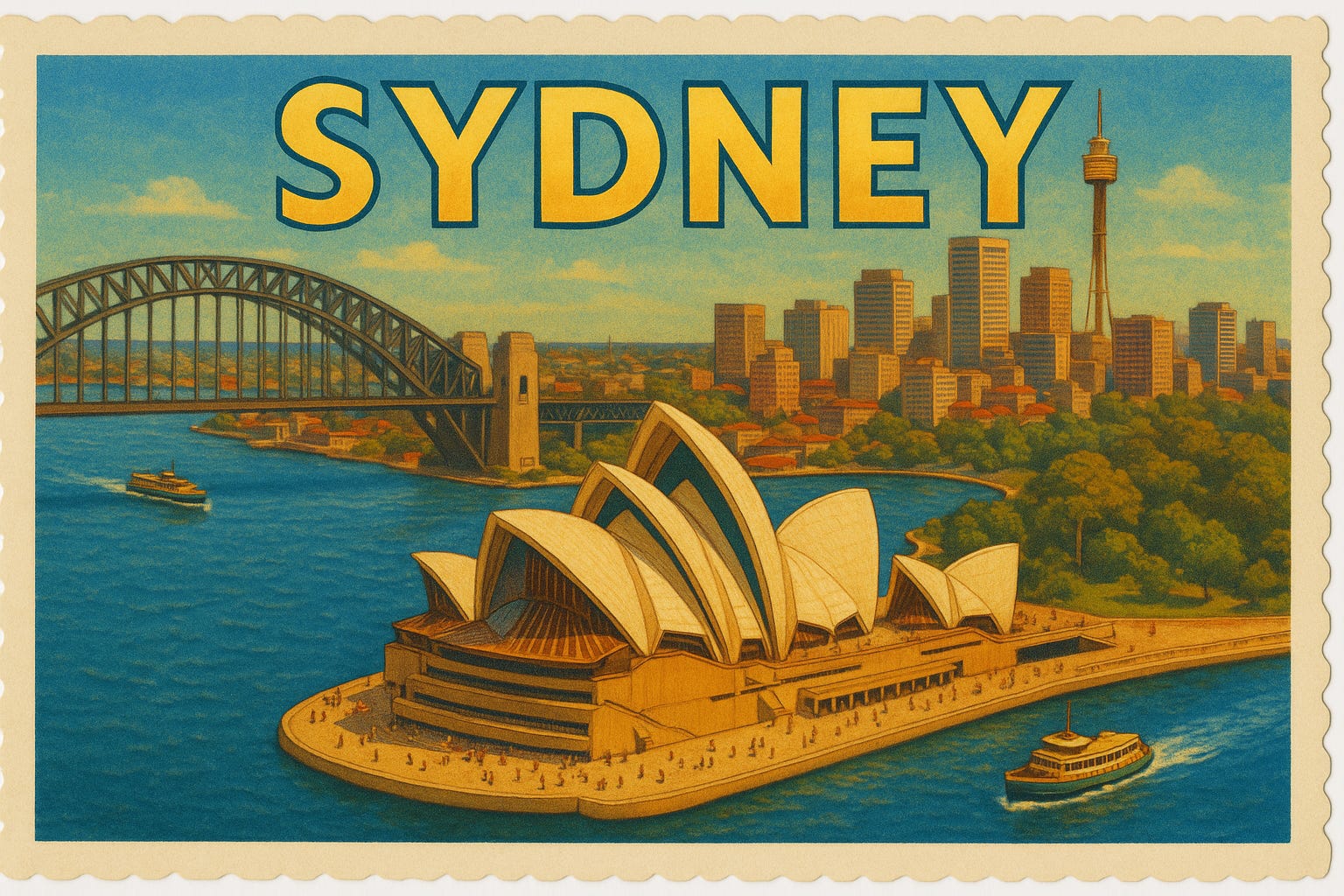
Two of the most vivid examples from the modern era stand almost at opposite ends of the architectural spectrum: Sydney’s Opera House, a beacon of futuristic creativity, and Warsaw’s painstakingly rebuilt Old Town, a declaration of cultural resilience. Both, in their own way, broadcasting their nations’ messages to the world: “Here we are; know us this way.”
When Jørn Utzon’s design was selected in 1957 (and how it was selected is a story unto itself,) Australia was still formulating its identity – not merely as an outpost of the British Empire, more than just a rugged frontier society, and something new, something bright. Utzon’s soaring, shell-like structures, inspired partly by nature, partly by the geometry of fully filled sails powering an elegant vessel towards new horizons, captured a spirit Australia wanted the world to associate with it. Here was a country, the building seemed to say, that embraced a bold vision, defied expectations, and was unafraid of looking forward.
It hardly mattered that the Opera House’s construction would ultimately run massively over time and budget, or that Utzon himself resigned before it was ever finished. When the building was finally unveiled in 1973, it offered Australia not just a performing arts centre but a totem of identity.
In architectural form, Australia planted its flag on the soft-power landscape. (When the groundbreaking Day in the Life of Australia book was published in the early 80s, the team photo of the 100 of the world's leading photojournalists who shot it was, of course, taken on the steps of the Opera House.) Even today, the Opera House is one of the most instantly recognisable symbols of any nation anywhere in the world. The simplest squiggle of it is an instantly recognisable logo for “this has got to be Australian.” Few visitors can resist photographing it; few international broadcasts from Sydney fail to feature it.
If the Sydney Opera House looks forward, Warsaw’s rebuilt Old Town looks backward, but no less meaningfully. Flattened by the Nazis in World War II, Warsaw faced a grim choice in the late 1940s – build anew on the ashes of five hundred years of history, or reconstruct the past in almost defiant fidelity. Poland chose the latter. Using 18th-century paintings by Bernardo Bellotto (also known as Canaletto) as guides, Warsaw meticulously rebuilt its historic centre.
Zbigniew Krawczyński, a Warsaw architect, played a pivotal role in the post-World War II reconstruction of the Old Town. In 1952, after immersing himself in historical research of the visual archive of the city he loved, he created a hand-drawn panorama, faithfully presenting the area in its pre-war glory. This served as a critically important document which guided much of the meticulous rebuilding. His work helped Warsaw reclaim not just the streets and squares of the Old Town, but its very identity.
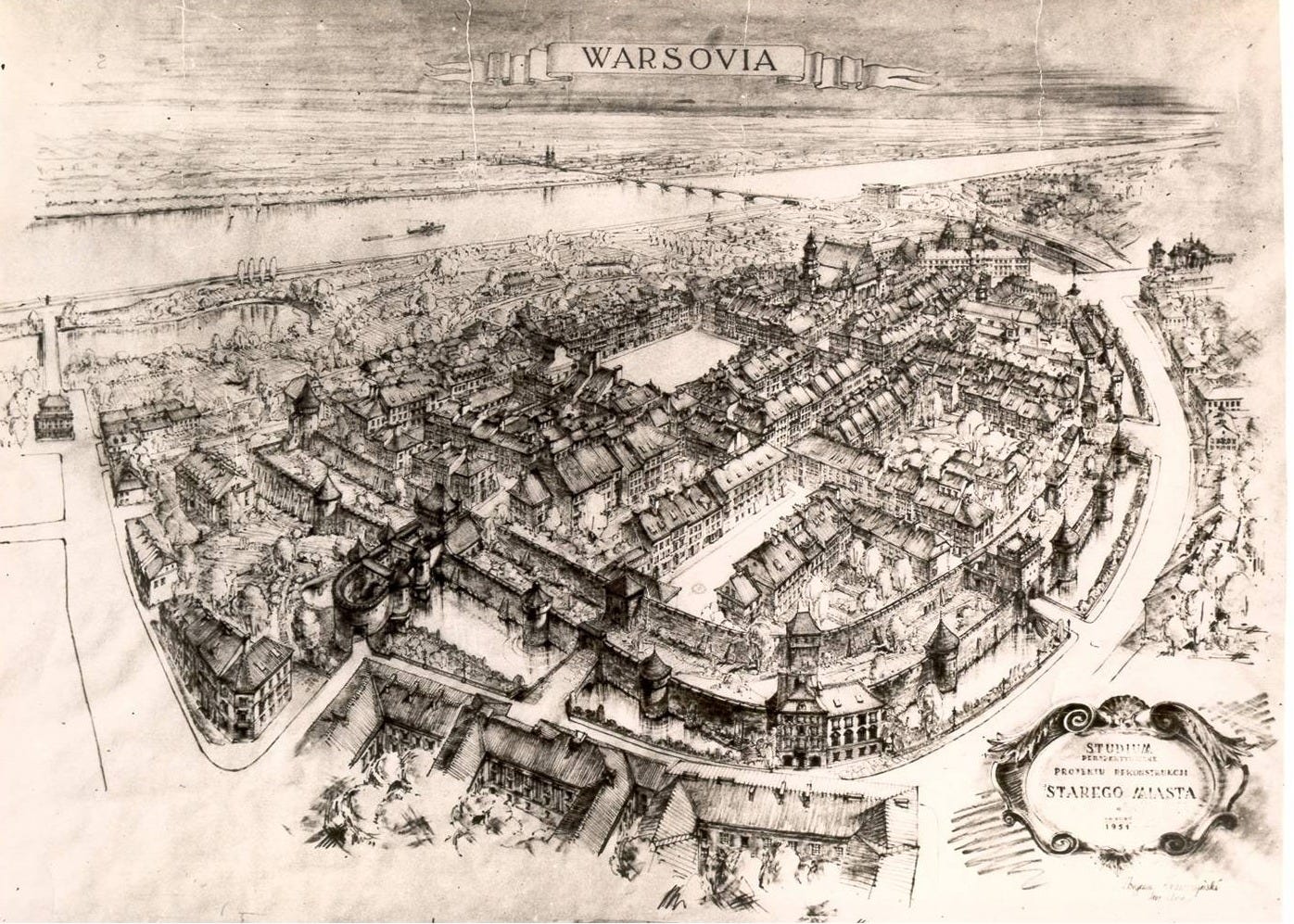
The effort was not about nostalgia; it was about survival. In reclaiming its destroyed architecture, Poland reclaimed its interrupted narrative. The rebuilt Old Town, down to the subtle irregularities of medieval walls and the careful recreation of Renaissance façades, was a statement: “You tried to erase us. We are still here.”
Today, millions of visitors walk cobbled streets that are therefore, paradoxically, both ancient and new. UNESCO recognised the reconstruction as a World Heritage Site, not because of its age but because of its meaning. Here, architecture served less as art and more as a medium of cultural defiance; a vital assertion of national continuity in the face of obliteration. (As an unintended parenthesis, the inferior quality of building materials available in mid-1950s communist Poland has meant that today the Old Town really looks uncannily like it was built during the Renaissance, even if the houses are maybe only eighty years old.)
Adding a remarkable human thread to this story is the Krawczyński family. Decades later, Zbigniew's son, Mark, would become a key figure in Australia’s architectural landscape, managing the complex task of finishing and strengthening the Sydney Opera House. Mark’s work included enhancing the building’s resilience against the unrelenting work of the sea, and ensuring Utzon’s visionary design could perform its intended role well into the future.
Through their work, father and son, in two very different hemispheres, with two very different architectural missions, demonstrated how architecture not only builds cities, but also builds bridges between nations.
The Krawczyńskis have been a living testament to how architecture, quietly but indelibly, weaves together the shared narratives of different peoples. And they are far from alone. Across the world, family ties and close mentorships have quietly carried architectural ideas across borders, embedding human connections into the structures we now take for granted. (Have a read about some more at the end of this article.)
Across the Atlantic, the Roebling family demonstrated how architecture and engineering could become acts of national storytelling. John A. Roebling, born in Prussia, emigrated to the United States in 1831 and brought with him European engineering expertise. His special power? Designing rope suspension bridges.
In his lifetime Roebling designed a number of bridges in the US and Canada but it is vision for the Brooklyn Bridge – a daring, elegant crossing – that has had the most lasting impact on the identity of the US, and New York City in particular. It was carried to completion by his son Washington Roebling and daughter-in-law Emily Warren Roebling. The bridge, an enduring symbol of American ambition and optimism, stands not just as a feat of engineering, but as an emblem of a young nation projecting itself into the future.
Not all architecture that contributes to national identity arrives in brilliantly iconic packages, however. Sometimes, it is the quieter gestures that, collectively, build an enduring sense of self.
Consider Finland’s much loved community libraries, eighteen of them designed by Alvar Aalto. Modest, human-scaled, and imbued with a democratic spirit, they reflect Finland’s self-image as a country of educated, egalitarian citizens. No grandiosity, no fanfare, but an architectural message all the same: “We are thoughtful; we are open; we value every person who walks through these doors.”
Sometimes it is tradition, not a famous architect, who takes the design lead, as in the case of the Moroccan riad houses: inward-facing, humble from the street, but full of ornate beauty inside. They speak of a culture that values privacy, family, and hospitality—an architecture of inward riches.
Small-scale vernacular architecture tells a story of climate, culture, and collective values. Look at the whitewashed Cycladic houses in Greece, the timber-framed houses of Germany’s Black Forest, or Japan’s ryokans – some of them over a thousand years old. Together, such build an unloud but powerful sense of national identity: less an anthem, more a melody you find yourself humming.
Naturally, it all began a long time ago. In the time of the pharaohs, of course, the ruler WAS the nation. But let’s look a little closer to our time. Long before soft power had a name, the Athenians understood its principles. (Of course they did...) The Parthenon, completed around 438 BC, was many things: possibly a temple to Athena, a treasury, a demonstration of wealth, a focal point for political might. But above all, it was an assertion of identity. When the dust settled on the Persian Wars, Athens positioned itself as the leader of a new Greek cultural hegemony.
The Parthenon’s refined proportions, subtle entasis (the slight curvature of columns), and stunning sculptures projected the ideals of balance, reason, and civic virtue that Athens wished to associate with itself. Even as its original functions faded, the Parthenon endured as a symbol of “civilisation” itself. When 19th-century European powers sought to invoke the “glories of Greece,” it was the image of the Parthenon, damaged but dignified, that they summoned.
Architecture, it seems, can transcend even its own original political context to become an ambassador for ideas that reach further than the immediate talking points of any single era.
In the world of soft power, a nation’s architecture is never just about function. It is about communication – with its own citizens as much as with the world beyond. Architecture offers nations a way to say, “This is who we are.” The stones remember. The world watches. And sometimes, improbably, it falls a little bit in love.
The Olmsted Legacy: landscapes across continents
Frederick Law Olmsted’s belief that parks could shape democratic societies didn’t stop at America’s borders. His sons, John Charles Olmsted and Frederick Law Olmsted Jr., expanded their father’s vision to Canada and Japan, advising on urban planning projects that subtly embedded the American ideal of public green space abroad. In their hands, the idea of the park as the people’s stage took root across continents, reinforcing an architecture of civic life that transcended national lines.
The Ponti Family: a dialogue between Italy and Latin America
Gio Ponti, the maestro of Milanese modernism, infused Italian elegance into the architectural dreams of Latin America during its postwar boom. His daughter, Lisa Licitra Ponti, an artist and architect in her own right, furthered this cultural dialogue through her editorial and curatorial work. The Ponti family’s reach—from Milan to Caracas—offered a version of modernity that was neither sterile nor purely functional, but lyrical, human, and deeply connected to place. Their influence marked a quiet but lasting cultural handshake between Italy and the Americas. Oh, and Gio founded the magazine Domus - to this day a keystone of purposeful dialogue about architecture. He did that in 1928.
The Perret Brothers: rebuilding ideas after ruin
In the early 20th century, Auguste and Gustave Perret revolutionised building with reinforced concrete in France. But after the devastating 1923 Kanto earthquake, their influence reached even further. Japanese architects, searching for new ways to rebuild resilient cities, drew heavily on the Perrets’ ideas, blending them with local traditions. Through technical innovation and aesthetic restraint, the Perrets helped Japan modernise its cities while preserving its cultural soul—a reminder that architecture can be an import not of domination, but of dialogue.