

Architecture& Language
Or, how not to convolute things beyond reasonable convolution

Welcome to The Arbours at Sycamore Vale: a pioneering lifestyle enclave reimagining what it means to dwell with intentionality in the heart of tomorrow’s peri-urban corridor!
More than just homes, this visionary master-planned microdistrict curates a symbiotic dialogue between heritage-inspired design language and next-gen infrastructural mindfulness. Each bespoke residence has been precision-engineered to nurture holistic live-work-play balance within a fully integrated amenity spine, including a contemplative water feature and exclusive resident-only connectivity hub!
The Arbours represents not merely a place to live, but a bold investment in spatial consciousness, regenerative placemaking, and the luxury of belonging!
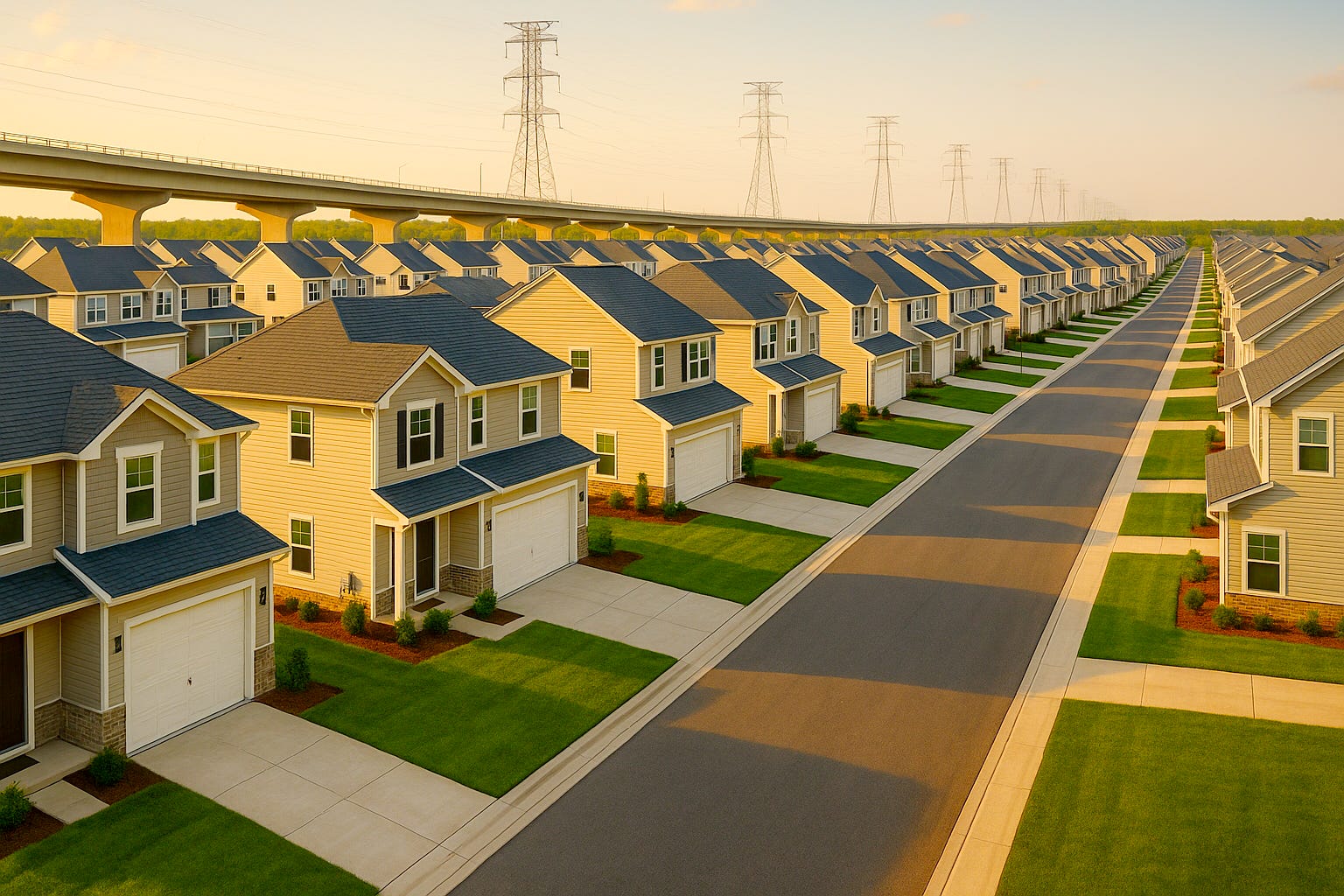
“At Sycamore Vale, we’re not just building homes—we’re curating a legacy of aspirational placemaking,” says Tristan Selfimportant-Hardnose, founder and visionary-in-residence at Hardnose Property Group. “It’s about crafting intergenerational value through elevated spatial narratives. Anyone can pour concrete; what we’re offering is a lifestyle continuum.”
You’ve met the CEO, now let me also introduce you to Cassia Moncrieffe de la Lune, Head of Experience Curation at Hardnose Property Group. She once storyboarded a short film about ennui in mid-century Helsinki before pivoting to spatial branding. Here’s her statement, delivered with calm intensity while standing beside a biomorphic art bench:
“Every journey through The Arbours is dramaturgically composed,” explains Cassia Moncrieffe de la Lune, MA (Film, UCL), adjusting the collar of her dove-grey Acne Studios suit jacket.* “We’re weaving cinematic resonance into the everyday—liminal transitions between public and private zones, choreographed lightplay across artisanal façades. It’s not just where you live. It’s where your narrative unfolds.”
•••
OK, so by now you have probably got the idea that 1. this is a joke, 2. I'm not really in the business of flogging blandsville subdivisions dressed up as “visionary master-planned microdistricts” which “curate a symbiotic dialogue between heritage-inspired design language and next-gen infrastructural mindfulness.”
Among other things, I'm in the word trade. Words are my friends, and I like to think that I treat them with respect, at least most of the time.
Not everyone who is in the word trade does, alas – as in the much repeated and usually misattributed, quote:
“Language is like a great ship — it is being built forward by poets and dismantled at the stern by admen.”
(Misattributed because we don't really know whether it was Cyril Connolly who said it, or Ezra Pound, or even George Steiner...)
The architecture game in particular has been subject to some unfortunate vocabwash, and lextraction**, leading to what the Estonian palaeontologist Ivan Puura called "semiocide" - the destruction of meaning. (He used that in a different, political, setting but if the hat fits...)
Some of the language one finds in architecture marketing literature is truly off the Archibollocks Index**, and requires a sterling attempt at translation, so as to glimpse what hides beneath the attactive veneer.
So here is a handy lexicon of placemarquetry, with translations. Of course, you are most welcome to extend it, remix it, curse it, or nurse it, or give it a new name (David Gilmour fans will get this one.) One day, I might publish it as a suitably inclusive, non-confrontational, environmentally friendly and inoffensive dictionary. Not today, though. Today it's let it rip time.
* I don’t actually know if Acne Studios make a dove grey suit, but it sounds like they ought to.
** “Through sustained processes of lextraction, value-laden terms like ‘sustainability’, ‘placemaking’, and ‘community’ are repurposed into sleek, surface-level signifiers in service of aspirational design narratives.”
*** The Archibollocks Index (ABI) : The ABI rates language inflation and conceptual vacuity in built environment rhetoric. Low ABI: “Timber, glass, and stone — built for everyday use.” High ABI: “An immersive, biophilic interface between wellness trajectories and smart dwelling ecosystems.”
So, here goes:
Developerese marketingese, translation optional
World-class – Every new development is apparently “world-class.” Who’s checking?
Visionary – A glass box with strip lighting, and maybe a gravel garden out back.
Destination – Overpriced sandwiches? Bad coffee? No parking? Pick any two.
Gateway – A lonely tower block at a roundabout in the middle of Almostnowhere.
Master plan – A spreadsheet in disguise.
Iconic skyline addition – Tall, shiny, out of scale. Impressive, but for the wrong reasons.
Luxury living – Small units, large marketing budget. There's a golf course within two hours’ drive.
Affordable luxury – Utterly meaningless oxymoron. I don't even know how to translate that one.
Boutique development – Six units and no lift. Painted pink.
Planning buzzwords wearing high heels, or while wearing high heels
Walkable – Any place where you won’t immediately be hit by a car.
Transit-oriented development (TOD) – Next to a bus stop that nobody has used in years.
Complete streets – With a cycling lane wedged between parked cars and angry vans.
Urban village – Five towers, a wine bar, and no post office, but it has a fountain.
Revitalisation – We kicked out the old tenants.
Brownfield opportunity – We found a contaminated car park!
Marketing fluff meets design fluff
Inspired by nature – It’s beige with a fern in the lobby; and a small waterfall.
Celebrating heritage – We left four original bricks in the foyer. (Feng Shui angle built in.)
A dialogue with the street – The building has windows, presumably.
Reinterpreting tradition – Brutalist meets yoga studio.
Paying homage – Copy-pasted a cornice from Google Images.
Contemporary reinterpretation – Not actually contemporary, but we hoped you wouldn’t notice.
Corporate urbanism babble
Future-proofed – It really shouldn't fall apart by this time next year.
Agile space – You get a chair and a folding table. You can move both of those.
Synergistic design process – A three-hour Zoom call and no decisions, but lots of pointless activity.
Co-creation – You were invited to a consultation and ignored.
Stakeholder engagement – We asked three people and sent a PDF.
Pseudo-intellectual flair
Narrative-driven design – Like storytelling, but for bricks.
Spatial experience – It’s a hallway.
Material honesty – Concrete. Again. No, really. It is.
Sensory landscape – We planted lavender.
Temporal layering – It’s old and new. That's it.
Intellectually-dressed nonsense
Narrative architecture – Supposedly means a building tells a story. Often, it just means it has curves.
Material honesty – Originally about truth to materials (a noble Modernist ideal), now thrown at any project with exposed concrete.
Legibility – Meant to indicate clarity in spatial organisation; often used to justify oversimplification.
Porosity – Once a useful term for permeability and pedestrian flow; now applied to anything with gaps in it. Winds love that.
Dialogic relationship – Between buildings or eras. Translation: “This doesn’t quite fit, but let’s call it a conversation.”
Civic generosity – Vague moral positioning used to describe wide stairs, oversized lobbies, or landscaped leftovers.
Urban acupuncture – Fancy way to say “we plonked a small intervention here and hoped it ripples out.”
Packaging the generic
Boutique development – No longer denotes quality or uniqueness; now just means “small, expensive and poncy.” Or just small and expensive, with not enough of the ponce.
Lifestyle precinct – What was once a neighbourhood, now curated like a luxury brand. ROI looking good.
Destination space – If you have to declare it a destination, it probably isn’t one. Might become one in another generation.
Urban oasis – Almost always artificial, gated, and unsustainable.
Design-led – Used to cover a multitude of sins, especially bad urban economics.
Delusional descriptors
Seamlessly integrated – Almost always anything but.
Bold vision – A euphemism for hubris.
Pioneering approach – Usually means it's being tried out on a low-income neighbourhood.
Next-generation infrastructure – Sounds tech-forward; rarely is.
Game-changing – Almost always overstated.
Transformative – A favourite of grant applications; meaning varies wildly. Some would call it flailing about.
Trendy but hollow
Disruptive architecture – As if buildings were startups. And this were a good thing.
Pop-up urbanism – Sometimes interesting, more often a distraction from systemic issues.
Agile spaces – The open-plan office of the urban realm—fleetingly fashionable, frequently hated.
Tactical urbanism – Can be genuine grassroots action, but is often co-opted to excuse temporary fixes in place of real investment.
Design thinking – Once fresh; now a corporate ritual disconnected from deep creative processes.
Subtly sinister euphemisms
Reactivation – Often a code word for gentrification.
Upgrading – Might mean better lighting—or displacing a whole community.
Densification – Technically correct, politically fraught. Can mean thoughtful infill or careless overdevelopment.
Heritage-sensitive – Occasionally true; more often, a fig leaf.
Unlocking potential – Property developer for “we want to build a tower here.”
Chronically overused
Vibrant – A favourite filler for places that lack any actual life.
Iconic – Everything’s iconic now: buildings, benches, bin enclosures.
Sustainable – Often thrown around without actual data or long-term thinking.
Smart – “Smart cities” still struggling with basic infrastructure.
Green – Can mean anything from a potted plant to a fully re-wilded roof.
Innovative – So overused it’s become meaningless unless backed up with substance.
Resilient – Used post-disaster or in climate contexts, but often without a plan.
Inclusive – A great concept, but too often just lip service in brochures.
Human-centred – Applied to things that remain cold, corporate and top-down.
Authentic – Ironically, applied to spaces deliberately manufactured to feel “real.”
Dynamic – Usually means “we don't quite know what’s going on here yet.”
Urban jargon bingo
Mixed-use – Now means “some shops and maybe a gym under apartments.”
Activated streetscape – A planner’s dream, a real-world maybe.
Placemaking – Once radical, now slapped on every new plaza. Or mural. Or, yes, fountain.
Creative precinct – Just add fairy lights and a coffee cart. Beanies and beards obligatory.
Live-work-play – Sounds utopian, often just unaffordable real estate for those who engage in two of the three.
Urban fabric – When in doubt, blame or praise the fabric.
Curated experience – Code for “someone designed this to feel spontaneous.” There’s another one like it, four km up the road.
Third space – Coffee shops were third spaces before it was a thing.
Design-speak drift
Timeless – More often a euphemism for bland, catering to everyone, and therefore no-one.
Contextual – Allegedly refers to surrounding buildings, sometimes just an excuse.
Minimalist – Aesthetic stripped of meaning. Or furniture. Probably in concrete.
Bold yet sensitive – Sounds like a shampoo ad. Looks like a shampoo ad.
Reimagined – Almost always means “demolished and replaced.”
Greenwashing & techwashing buzz
Net-zero-ready – “We’ll get around to it, promise.”
Carbon-neutral materials – Used with suspicious ease. (“Carbon-free” is the imbecile version.)
AI-powered design – Usually just a spreadsheet and a hopeful intern with access to a free account.
Biophilic design – A houseplant in the lobby.
Circular economy principles – Rarely understood, often misused, most often not very circular.
Buzzwords with identity crises
Threshold spaces – You mean... a hallway?
Negotiated edges – Oh, like a footpath that almost lines up with a bench.
Blurred boundaries – Sexy-sounding, but often just confusing transitions between public and private. If that’s your thing…
Fractured geometries – Because “weird angles” didn’t sound academic enough.
Non-linear circulation – Just admit no one can find the front door.
Architecture as metaphysics
Built dialogue – Sounds poetic. Usually means one building is shouting and the other is ignoring it.
Architectural language – A common excuse for incoherence: “You just don’t speak this language.”
Spatial choreography – Walk here, now pivot dramatically, ascend heroically. Repeat.
Sacred geometry – Beloved by YouTube mystics. And “life coaches.”
Ritualised entry sequence – Apparently, walking through a door is now a rite of passage.
Loud words for quiet spaces
Monumental yet intimate – Pick a lane. Stay there.
Expressive roofline – A euphemism for “we blew half the budget on weird angles.”
Volumetric complexity – Big blocks, on top of other big blocks.
Tectonic clarity – Could also be describing a geology textbook.
Techno-utopian nonsense
Parametrically optimised envelope – Sounds smart. Might just be a wobbly facade with a big fuck-off RSJ across the top.
Digital twin urbanism – The city… but in The Matrix.
Responsive environment – It lights up when someone walks past. Not creepy at all.
Autonomous mobility corridors – Just say “roads with robot cars.”
Metaverse-ready public realm – This actually appeared in a real brochure. Pray for us.
Developer speak in a tux
Architectural integrity – Often a last-ditch PR move after something’s been value-engineered to death.
Holistic placemaking solution – A roundabout with planters.
Premium grade amenity offering – The gym has towels.
Dwell-time maximisation – We want you to hang around (and spend money).
Curated tenant mix – No kebab shops, sorry.
The green-gloss glossary
Living architecture – Could mean a green roof… or that it leaks.
Low-impact development – Until you count the parking structure.
Bio-integrative – I’m sorry, what?
Eco-sensitive intervention – We cut down some trees very gently.
Net positive spaces – Sounds lovely. Measures nothing.
Bonus round: words that just sound fancy
Interstice – A poetic way to say “gap.”
Palimpsest – Cool in theory. Misused constantly.
Rhizomatic – For when someone’s read Deleuze and wants you to know it. (Would that be deleuzional?)
Liminal – Once meaningful, a really good word, that. Now the reheated croissant of design words: everywhere, overly flaky, and vaguely French.
Ephemeral – We mean temporary, but let’s make it sound wistful.
•••
So, now that you have managed to wade, waddle and push through the above, what should an architecture marketer do with words instead? Well, it’s actually not that difficult. When communicating about architecture, space, and cities, (or pretty much anything else for that matter) the antidote to buzzword inflation is specificity:
Who is this for? What does it actually do? Be specific.
How does it feel to be there, in body, and time? In different weather? Be evocative (not sentimental.)
What tensions does it resolve, or aim to create? (Be descriptive, but avoid adjectives.)
Yes, it is entirely possible to be poetic while telling it as it is.